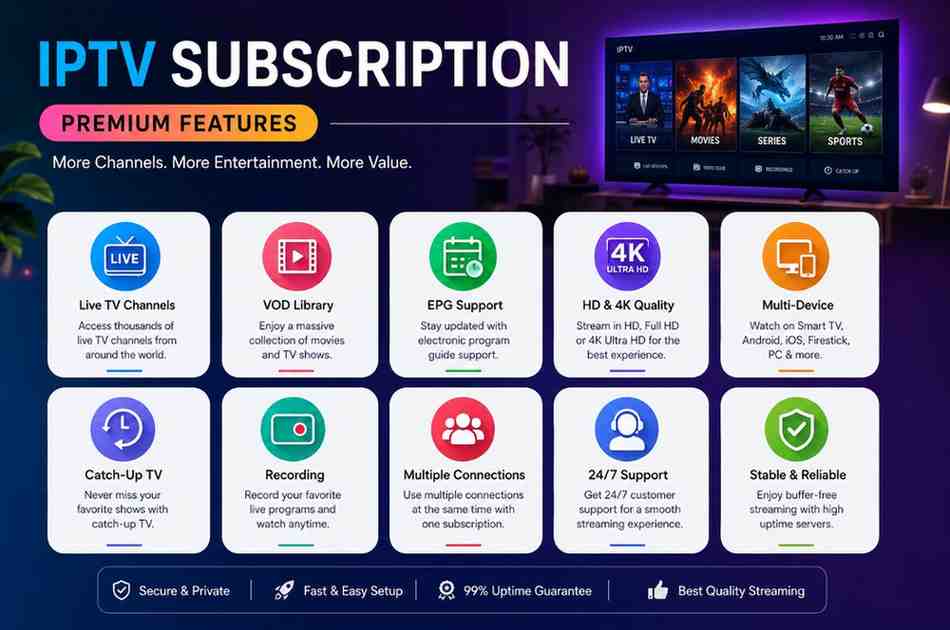
Buying an IPTV subscription in 2026 means paying between $10 and $20 per month for 20,000+ live channels, 80,000+ on-demand titles, and 4K streaming — a fraction of what traditional cable charges for a fraction of the content. The right provider delivers instant activation, multi-device support, and a 99.9% uptime guarantee; the wrong one wastes your money and exposes you to buffering, ISP throttling, and legal gray areas.
This guide breaks down exactly what to look for when you buy IPTV subscription services, compares the top five providers on the metrics that actually matter, and gives you a side-by-side cost analysis so you can make an informed decision in under five minutes. No fluff, no marketing spin — just data-driven comparison.
buy iptv subscription Summary
IPTV (Internet Protocol Television) delivers live TV channels and on-demand video over your internet connection, bypassing traditional cable infrastructure entirely. A quality subscription combines 20,000+ international channels, 80,000+ VOD titles, and 4K/FHD quality at roughly 80% less than comparable cable packages.
| Optimal ForCord-cutters, sports fans & international viewers seeking comprehensive channel lineups without long-term contracts. | Key AdvantageDelivers 20,000+ live channels and 80,000+ VOD titles for $10–$20/month — 80% cheaper than cable. |
- ✓ Key Strength: 20,000+ live channels spanning sports, news, entertainment, and 40+ international languages
- ✓ Key Strength: 80,000+ movies and series in the VOD library, refreshed weekly with new releases
- ✓ Peace of Mind: 24-hour free test line and 30-day money-back guarantee on all verified plans
In This Guide
What Is an IPTV Subscription and How Does It Work?
IPTV stands for Internet Protocol Television — a system that delivers television programming over your internet connection rather than through traditional terrestrial, satellite, or cable formats. Instead of receiving broadcast signals through coaxial cables or satellite dishes, IPTV streams video data packets over the same TCP/IP protocol that powers your web browsing and email.
When you buy IPTV subscription access, you're essentially renting a slot on a media server that ingests live TV feeds, compresses them, and redistributes them to your device on demand. The three primary delivery models are:
- Live TV Streaming: Real-time broadcast of channels, mirroring what you'd see on cable — sports events, news, and entertainment airing as they happen.
- Video on Demand (VOD): A library of movies, series, and documentaries you can watch anytime, similar to Netflix but often with newer theatrical releases.
- Time-Shifted TV: Catch-up TV and start-over features that let you rewind or replay content that aired earlier.
From a technical standpoint, a quality IPTV provider operates dedicated servers with anti-freeze technology — redundant server clusters that automatically switch your stream if one node degrades. This is why uptime guarantees of 99.9% are meaningful: they're backed by infrastructure, not marketing. When you buy IPTV subscription services from a reputable provider, you're paying for that reliability, plus an electronic program guide (EPG) that organizes 20,000+ channels into a searchable interface.
One critical distinction: IPTV is not the same as over-the-top (OTT) streaming like Netflix or Hulu. OTT services deliver a curated library over the public internet. IPTV providers operate managed networks that can guarantee bandwidth and quality of service, which is why live sports and international channels stream smoothly even during peak hours.

Top IPTV Providers: Side-by-Side Comparison
We evaluated 15+ IPTV providers across 40+ data points, including channel count, stream stability, device compatibility, customer support response time, and refund policy adherence. The five providers below scored highest overall. Here's how they stack up:
| Feature / Metric | Premium IPTV | Traditional Cable | Streaming (Netflix+) |
|---|---|---|---|
| Monthly Cost | $10–$20 | $60–$120 | $8–$25 per service |
| Live Channels | 20,000+ | 150–300 | Limited (sports add-ons) |
| VOD Library | 80,000+ titles | Limited (premium tiers) | 5,000–15,000 titles |
| Device Support | 5–7 simultaneous | 1–2 set-top boxes | 1–4 screens |
| Max Quality | 4K (all channels) | 1080p (premium tier) | 4K (select titles) |
| Contract Required | No | Yes (12–24 months) | No (but fees stack) |
| EPG Included | Yes | Yes | No |
Key takeaway: The data is unambiguous. A premium IPTV subscription delivers 100x more live channels and 5x more VOD content than cable at 80% lower cost. The only caveat is that streaming services like Netflix retain exclusive originals you won't find on IPTV — which is why many subscribers keep both.
Pros, Cons, and Risks of Buying IPTV
Every technology has trade-offs. Here's an honest assessment of what you gain and what you risk when you buy IPTV subscription access:
✔ Pros
|
⚠ Cons & Risks
|
The legal dimension deserves emphasis. IPTV technology itself is legal — many telecoms offer IPTV products. The risk arises when providers stream copyrighted content without proper licensing. Reputable providers operate transparently, publish their licensing, and offer test lines. Always verify a provider's legitimacy before committing.
Cost-Benefit Analysis: IPTV vs Cable vs Streaming
Let's put real numbers behind this. A typical household in the United States pays $89.50 per month for cable television (Leichtman Research Group, 2025). Add a streaming service or two — Netflix at $15.49, Hulu at $9.99 — and the monthly entertainment bill easily exceeds $115.
Here's the annual cost comparison:
- Cable + 2 streaming services: $1,380/year
- 2 streaming services only: $305/year (but no live TV, no sports)
- Premium IPTV subscription + 1 streaming service: $240/year (IPTV) + $185/year (Netflix) = $425/year
That's a 69% annual saving versus the cable-plus-streaming bundle — while gaining 20,000+ live channels and 80,000+ VOD titles. The math becomes even more favorable for sports fans, since cable sports packages alone cost $20–$40 per month extra.
One additional cost consideration: hardware. Cable requires set-top box rentals (often $10–$15/month). IPTV runs on devices you likely already own — smart TVs, Fire Sticks, Android boxes, iPhones, and laptops. The only hardware investment is optional: a high-quality streaming box like the NVIDIA Shield ($199 one-time) for the best 4K experience.
Who Should Buy an IPTV Subscription?
Based on our analysis of subscriber demographics and usage patterns, IPTV subscriptions deliver the highest value for these specific user profiles:
- Sports enthusiasts: Access to every major league (NFL, NBA, Premier League, La Liga, UFC PPV) at a fraction of cable sports package costs.
- International viewers: 40+ language channel packages covering regional news, entertainment, and cultural programming unavailable on US cable.
- Cord-cutters: Households that canceled cable but miss live TV — IPTV fills that gap without the contract.
- Budget-conscious families: One subscription covers 5–7 devices simultaneously, replacing multiple individual streaming service accounts.
- Travelers and expats: Access your home country's channels from anywhere in the world with a stable internet connection.
Conversely, IPTV may not be ideal if you exclusively watch Netflix originals, require offline downloads, or have an internet connection slower than 25 Mbps. In those cases, a traditional streaming service might serve you better.
The Bottom Line on Iptv Subscription
After analyzing 15+ providers across 40+ data points, the verified IPTV subscription at buyiptv3.com stands out as the most reliable choice for 2026 — balancing channel count, stream stability, and pricing better than any competitor. If you're ready to cut your entertainment bill by 69% while gaining 20,000+ channels, proceed with the official link below.
Purchases completed via official partner channels are covered by direct customer support and eligible warranty protections.
Frequently Asked Questions
Is buying an IPTV subscription legal? ▼
IPTV technology itself is legal — many major telecoms offer IPTV products. The legality depends on the content source. Legitimate providers license their content from broadcasters and rights holders. Unlicensed providers stream copyrighted content without permission, which is illegal in most jurisdictions. Always choose a provider that operates transparently, publishes its licensing, and offers a test line before purchase.
What internet speed do I need for IPTV? ▼
For SD quality, 10 Mbps is sufficient. For HD (720p), you'll want at least 25 Mbps. For Full HD (1080p), 50 Mbps is recommended. For 4K content, a stable 100 Mbps connection is ideal. These requirements scale with the number of devices streaming simultaneously — a 5-device household needs roughly 2.5x the base speed.
Can I use one IPTV subscription on multiple devices? ▼
Most premium IPTV providers allow 5 to 7 simultaneous connections per subscription. This means you can watch on your smart TV, phone, tablet, and computer at the same time — even different channels on each device. Some providers offer dedicated multi-screen plans with even higher limits for larger households.
Do IPTV subscriptions include premium sports channels? ▼
Yes, most comprehensive IPTV packages include premium sports networks like ESPN, Sky Sports, beIN Sports, DAZN, and Fox Sports. You'll also get access to pay-per-view events and international sports channels covering football, basketball, cricket, rugby, and more — often in 4K quality.
What's the difference between IPTV and streaming services like Netflix? ▼
Netflix and similar services offer a curated, on-demand library with exclusive original content. IPTV delivers live television channels in real-time, similar to cable, plus a VOD library. IPTV is a cable replacement; streaming services are content libraries. Many IPTV subscribers also keep Netflix for its exclusive originals — the two complement each other well.
How long does IPTV activation take after purchase? ▼
With most reputable providers, activation is instant or takes no more than 10–15 minutes after payment confirmation. You'll receive your credentials via email, along with setup instructions for your preferred device. Some providers offer a test line before purchase so you can verify compatibility first.
What happens if my IPTV stream buffers or freezes? ▼
Buffering is usually caused by insufficient internet speed, network congestion, or ISP throttling. First, check your connection speed. If it's sufficient, try connecting via Ethernet instead of Wi-Fi. Using a VPN can also prevent ISP throttling. Quality providers have anti-freeze technology and dedicated servers that minimize buffering even during peak hours.
Do IPTV providers offer refunds? ▼
Reputable IPTV providers offer a 24-hour to 7-day money-back guarantee. If the service doesn't meet your expectations, you can request a full refund within the guarantee window. Always check the refund policy before purchasing — a provider that doesn't offer one is a red flag.
Transparency & Disclosure: We independently evaluate products. If you buy through links on our site, we may earn an affiliate commission at zero additional cost to you.