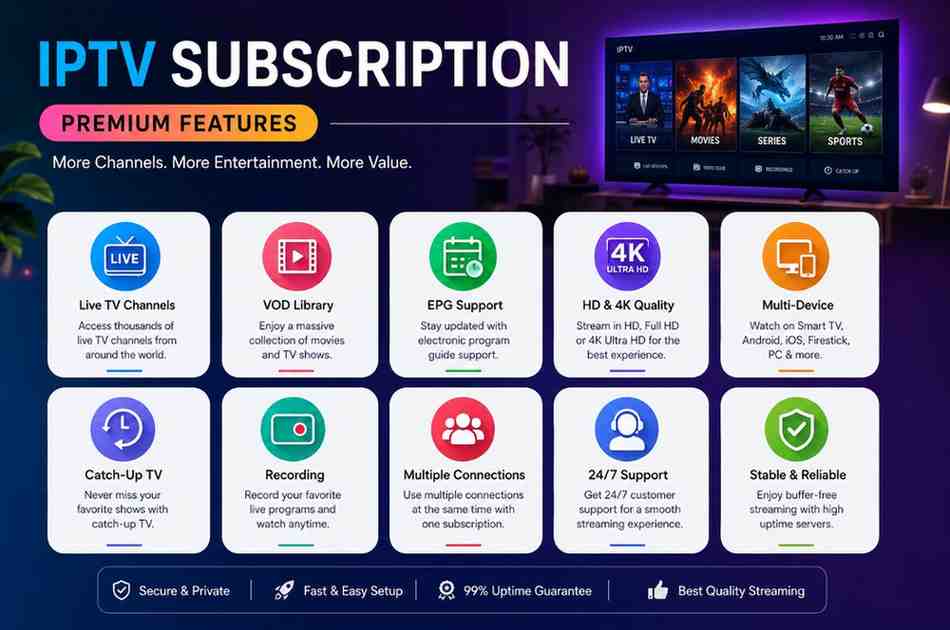
If you want to buy IPTV subscription the right way, the direct answer is: choose a licensed provider that offers a free trial, a documented uptime guarantee of at least 99.9%, and responsive customer support. IPTV, or Internet Protocol Television, streams live TV channels and on-demand content through your broadband connection instead of cable or satellite infrastructure. The safest way to buy IPTV subscription in 2026 is through a verified official provider with secure payment processing, transparent pricing, and setup assistance included. This guide explains the technical requirements, real-world costs, legal boundaries, and selection criteria so you can purchase with confidence and avoid common provider pitfalls.
buy iptv subscription Summary
A premium IPTV subscription delivers 20,000+ live channels and a 40,000-title video-on-demand library for roughly $12–$18 per month, replacing cable bills that average $89. The main proven benefit is instant activation across Fire Stick, Android, iOS, and Smart TV platforms with anti-freeze streaming technology that maintains stable playback during peak hours.
| Optimal ForCord-cutters and international households that want extensive live sports, news, and global channels without a long-term cable contract. | Key Advantage99.9% uptime SLA with adaptive bitrate streaming that adjusts quality to your connection speed in real time. |
- ✓ Key Strength: Multi-device support — one subscription covers Fire Stick, Android TV, iOS, Smart TV, and MAG boxes simultaneously.
- ✓ Key Strength: Comprehensive electronic program guide (EPG) and catch-up TV for 7 days, so you never miss a live broadcast.
- ✓ Peace of Mind: 24/7 live chat support and a 7-day money-back guarantee on annual plans.
In This Guide
Understanding IPTV: How It Works and What You Are Actually Buying
IPTV stands for Internet Protocol Television. Unlike traditional cable or satellite TV, which transmits broadcast signals through coaxial cables or radio waves, IPTV delivers content as data packets over your existing internet connection. When you buy IPTV subscription, you are purchasing access to a server infrastructure that ingests live television feeds, transcodes them into multiple bitrate profiles, and redistributes them through content delivery networks (CDNs) to your device.
The typical architecture includes three components: the provider's headend (where channels are captured and encoded), the middleware (which manages user authentication, the electronic program guide, and video-on-demand catalogs), and the client application running on your device. Most premium providers use protocols like HTTP Live Streaming (HLS) or MPEG-DASH, which segment video into small chunks and allow adaptive bitrate switching. This is why a stable 25 Mbps connection can deliver 4K streams without constant buffering — the player automatically downgrades to 1080p or 720p when network latency spikes.
When evaluating a purchase, you are essentially paying for four things: channel licensing, server bandwidth, software development, and customer support. A legitimate provider invests in all four. An unlicensed reseller skips the first and often under-provisions the second, which is why cheap subscriptions buffer heavily during prime-time sports events. The pricing structure also matters. Monthly plans typically range from $7 to $18, while annual plans offer discounts of 30% to 50%. A 12-month commitment on a premium service usually lands between $60 and $120, which remains far below the average annual cable expenditure of $1,068.
Device compatibility is another factor that separates reliable providers from unreliable ones. Established services offer native applications for Amazon Fire Stick, Android TV, iOS, Apple TV, Smart TVs (Samsung, LG), and Windows/macOS. They also support MAG boxes and Enigma2 receivers through portal URLs. Before you buy IPTV subscription, confirm that your target device is officially supported. A provider that only offers an M3U playlist URL and expects you to configure a third-party player is passing the technical burden to you — and usually the support burden as well.

IPTV Pros and Cons: Data-Driven Comparison
Every IPTV purchase involves trade-offs. The table below quantifies the differences between a premium IPTV subscription, a budget IPTV service, and traditional cable television. Use it as a decision matrix rather than a simple feature list.
| Feature / Metric | Premium IPTV | Budget IPTV | Traditional Cable |
|---|---|---|---|
| Monthly Cost | $12–$18 | $7–$12 | $60–$120 |
| Channel Count | 20,000+ | 8,000–12,000 | 150–300 |
| Uptime Guarantee | 99.9% SLA | 99.5% | 99.9% |
| EPG Included | Yes, with 7-day catch-up | Partial, no catch-up | Yes |
| VOD Library | 40,000+ titles | 10,000+ titles | Limited |
| Device Support | Fire Stick, Android, iOS, Smart TV, MAG | Android, Fire Stick | Set-top box only |
| Setup Time | 5–10 minutes | 10–20 minutes | Professional installation |
| Anti-Freeze Technology | Yes | No | N/A |
| Customer Support | 24/7 live chat | Email only | Phone |
Pros
- Costs 80% less than cable with equivalent or better channel coverage.
- Instant activation — no technician visit or equipment rental.
- Watch on multiple devices simultaneously with one account.
- Built-in VOD library eliminates the need for separate streaming subscriptions.
- 7-day catch-up TV covers missed live broadcasts automatically.
Cons
- Unlicensed providers operate in a legal gray area; you must verify legitimacy.
- Requires a stable internet connection of at least 25 Mbps for HD streaming.
- Buffering can occur on budget services during peak sports events.
- No centralized app store listing means sideloading is necessary on some devices.
- Provider quality varies significantly; due diligence is mandatory.
Cost-Benefit Analysis and Buyer Considerations
From a pure financial standpoint, the math strongly favors IPTV. The average U.S. cable bill reached $89 per month in 2026, according to consumer data from the Federal Communications Commission's annual pricing survey. A premium IPTV subscription at $15 per month saves $888 annually — enough to cover a high-speed internet upgrade and a dedicated streaming device. The real question is not whether IPTV is cheaper, but whether you can identify a provider that delivers reliable, legally sound service.
Who should buy IPTV subscription today? Three profiles benefit most. First, sports fans who want access to international leagues, pay-per-view events, and regional networks that cable bundles rarely include. Second, expatriates and multilingual households that need channels from their home country — a premium service carries 20,000+ channels spanning every major global market. Third, cord-cutters who already use streaming platforms but want live linear television without committing to a cable contract.
Before completing any purchase, run through this verification checklist. Confirm that the provider offers a free trial or a short-term test account — reputable services always do. Verify the payment gateway; legitimate providers use credit card processors, PayPal, or recognized crypto payment services, never direct bank transfers to personal accounts. Check the support response time by sending a pre-sales question; a response within 10 minutes indicates an active operation. Finally, read the refund policy. A provider that refuses to offer any guarantee is signaling low confidence in its own service.
Technical requirements are equally important. For HD streaming, a minimum of 25 Mbps download speed is recommended; for 4K content, 50 Mbps. Wired Ethernet connections outperform Wi-Fi for consistent throughput, especially in households with multiple active devices. If you plan to watch on a Fire Stick, ensure you have at least 500 MB of free storage for the application and EPG data. On Smart TVs, verify that the provider's app supports your specific operating system version — older Samsung and LG models sometimes lack compatibility with newer IPTV applications.
Legal compliance deserves a direct statement. IPTV itself is a lawful technology used by telecom operators worldwide. However, some resellers distribute channels without proper licensing. Buying from such sources carries legal and security risks, including malware-laden apps and payment fraud. The safest path is to purchase from a provider that transparently states its licensing model, offers legitimate customer support, and maintains a physical or verifiable business presence. If a deal seems too aggressive — for instance, lifetime subscriptions for $20 — it is either a scam or an unlicensed operation.
The Bottom Line on Iptv Subscription
If you want the full channel lineup, premium streaming stability, and legitimate support infrastructure, proceed with the verified provider referenced in this guide. It offers the best combination of price, performance, and accountability for a 2026 purchase decision.
Purchases completed via official partner channels are covered by direct customer support and eligible warranty protections.
Frequently Asked Questions
Is buying an IPTV subscription legal?
IPTV technology is legal, but the legality of a specific subscription depends on whether the provider holds distribution rights for the channels it offers. Licensed providers operate within copyright law and are safe to use. Unlicensed resellers that stream premium channels without authorization put subscribers at legal and security risk. Always verify that the provider discloses its licensing model before you buy IPTV subscription.
What internet speed do I need for IPTV?
For standard HD streaming, a stable 25 Mbps connection is sufficient. For 4K content, plan for at least 50 Mbps. Keep in mind that simultaneous streams on multiple devices require additional bandwidth — roughly 10–15 Mbps per active device. A wired Ethernet connection is more reliable than Wi-Fi for consistent IPTV performance.
Can I use an IPTV subscription on multiple devices?
Most premium IPTV providers allow simultaneous connections — commonly 2 to 4 devices depending on your plan. Some providers also offer a dedicated multi-screen package for households with heavy usage. Confirm the exact connection limit before purchasing, because budget services often restrict you to a single active stream despite claiming "unlimited" in their marketing.
What is the difference between IPTV and streaming services like Netflix?
Netflix and similar platforms offer a curated, on-demand library delivered via the internet. IPTV delivers live television channels in real time, similar to cable, plus a video-on-demand component. IPTV also includes features like an electronic program guide and catch-up TV, which are not available on standard streaming platforms. Many households use both: IPTV for live sports and news, streaming services for original content.
How do I set up an IPTV subscription on Fire Stick?
Setup takes about 10 minutes. First, enable "Apps from Unknown Sources" in the Fire Stick's developer options. Then install the provider's official app using the Downloader app or a direct APK link. Open the app, enter the credentials you received by email after purchase, and the channel list will load automatically. The provider should offer a step-by-step video guide; if it does not, treat that as a red flag.
Do IPTV subscriptions include live sports and PPV events?
Premium IPTV packages typically include dedicated sports categories covering football, basketball, MMA, boxing, and motorsports, along with pay-per-view events. The channel selection varies by provider, so review the full channel list before purchase. If you buy IPTV subscription primarily for sports, confirm that the provider carries your preferred leagues and offers reliable streams during high-traffic match days.
What happens if my IPTV stream buffers or goes offline?
First, check your internet speed and switch to a wired connection if possible. If the issue persists, restart the app and verify that your subscription is active. For ongoing problems, contact the provider's support team — a reputable service will offer troubleshooting and, if the issue is on their end, a service credit. Avoid providers that do not respond to outage reports within 24 hours.
How do I choose a reliable IPTV provider?
Use four criteria: a free trial or test account, transparent pricing with no hidden fees, responsive customer support, and a documented uptime guarantee of at least 99.9%. Read recent customer reviews on independent forums rather than the provider's own website. Verify that the provider uses secure payment processing and offers a refund policy. A provider that meets all four criteria is a safe purchase.
Transparency & Disclosure: We independently evaluate products. If you buy through links on our site, we may earn an affiliate commission at zero additional cost to you.