This article contains affiliate links. If you buy through them, we may earn a commission at no extra cost to you. Learn more.
Quick Start
Get a premium IPTV service running on Firestick, Android TV, or your phone in about 15 minutes — this beginner's walkthrough covers player setup, EPG, catchup, and the buffering fixes that actually matter.
In Brief
- A premium IPTV service setup needs only three things: a subscription, a player app, and a stable internet connection.
- Most setup failures come from mixing up Xtream Codes and M3U login details — not from the service itself.
- Buffer-free streaming depends more on player settings and network quality than on the provider's advertised speeds.
- Look for providers that offer trials, multi-screen access, and catchup — these signal a serious operation.
On this page
A premium IPTV service lets you stream live television over the internet — sports, news, movies, and international channels — without a cable box or satellite dish. If you've just bought a subscription and feel stuck, this guide is for you. The entire setup takes about 15 minutes and breaks down into four steps: choose a provider, collect your login details, install a player app, and configure everything for your home network. Below, each step is explained in plain language, with the beginner traps called out before you trip over them.
What You'll Accomplish
By the end of this guide, you'll have a fully working IPTV setup on your preferred device. That means your channel list will be loaded, the electronic program guide (EPG) will show what's on now and next, and catchup will work on compatible channels. You'll also know how to adjust buffer settings to reduce stuttering during live sports, and how to verify that your subscription supports multiple screens if you live in a multi-device household. No prior experience with IPTV is assumed — every step below assumes you're starting from zero.
What You Need Before Starting
Before you begin, gather four things:
- A premium IPTV subscription. The provider sends you login details by email, usually within minutes of purchase. If you haven't subscribed yet, choose a provider that offers a trial or a monthly plan before committing to a reliable premium IPTV yearly subscription.
- A compatible device. Firestick, Android TV box, smart TV (Android or webOS), phone, or tablet all work. The examples below focus on Firestick because it's the most common setup.
- An IPTV player app. TiviMate, IBO Player, and IPTV Smarters are the three most popular options. All are free to try.
- Decent broadband. You need about 25 Mbps for HD streaming and 50 Mbps or more for 4K. If your connection is slower, a premium IPTV service with no buffering is still achievable, but you'll need to lower the stream quality in your player settings.
Step 1: Choose a Premium IPTV Service — What to Watch For
Choosing the right provider matters more than any other decision in this guide. A cheap service with unreliable servers will buffer at the worst moments — usually during a live match or a season finale. Here's what to check before you hand over any money.
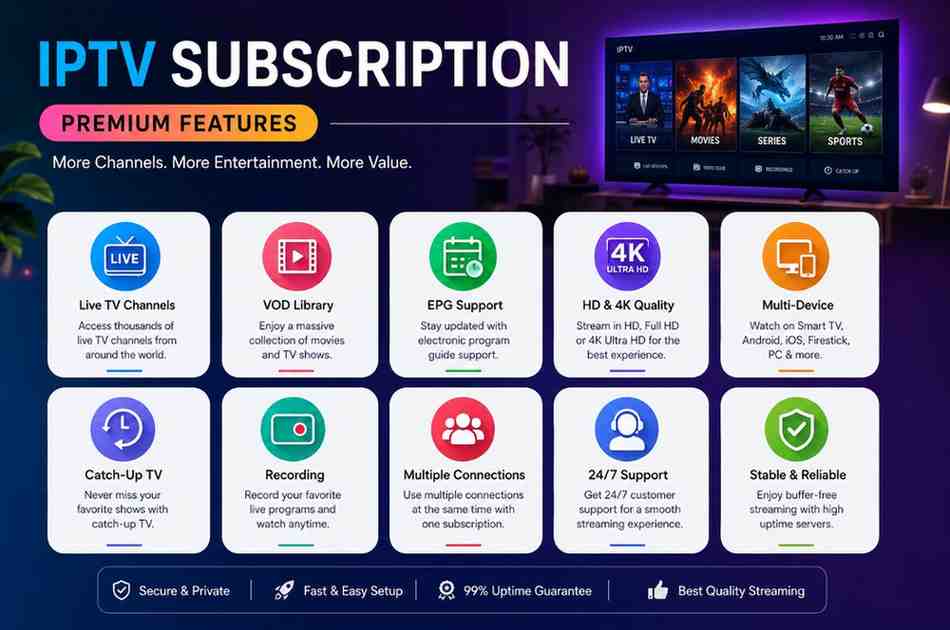
Server reliability. Look for providers that have operated for several years and publish uptime statistics. Trusted IPTV providers with 99.9% uptime are rare, but they exist. If a provider won't share basic operational details, treat that as a red flag.
Channel lineup. Count the channels you'll actually watch, not the total channel count. If you care about exclusive premium IPTV European channels, confirm they're in the package before subscribing. Most providers publish their full channel list on their website.
Multi-screen allowance. If you have a multi-screen household — two TVs running at the same time, or a TV plus a phone — check how many simultaneous connections the plan allows. Some providers charge extra for a second screen; others include it in the base price.
Catchup features. A premium IPTV service with catchup features lets you watch programs that aired in the past 24 to 72 hours. This is a must-have if you miss live broadcasts regularly and don't want to rely on a separate DVR.
Payment flexibility. Never start with a long commitment. Use a trial or a one-month plan to test the service. If it performs well on your network and your device, then consider a reliable premium IPTV yearly subscription to reduce the monthly cost. An affordable premium IPTV under $5 per month is realistic on a yearly plan, but only if the service actually delivers the channels you watch.
Step 2: Get Your Login Details Right — Common Mistakes
After you purchase, the provider sends an email containing either an M3U URL or Xtream Codes login credentials. Some providers send both. These details are the keys to your service, and this is where most beginners make their first mistake.
M3U URL is a direct link to your channel playlist. It looks something like this: http://provider.com/get.php?username=yourname&password=yourpass&type=m3u. You paste this entire link into your player.
Xtream Codes is a login method using three pieces of information: a portal URL, a username, and a password. Many players have a dedicated Xtream Codes login screen that asks for exactly these three fields.
The most common mistake is confusing the two. If you paste an M3U URL into an Xtream Codes field, the player will reject it. The second most common mistake is using your account email and password from the provider's website — those are not the same as your IPTV login credentials. Save the credentials email somewhere safe immediately. A password manager or even a notes app works. You'll need these details every time you set up a new device.
If you're setting up a premium IPTV Firestick optimized setup, you'll also want to enable "Apps from Unknown Sources" before installing your player. More on that in Step 3.
Most buffering problems trace back to the player's buffer size setting, not the provider's server speed.
Step 3: Install and Optimize Your Player App
Your player app is the interface you'll see every day, so it's worth choosing carefully. TiviMate is the favorite for Firestick and Android TV — it has a polished interface, excellent EPG support, and catchup built in. The free version is limited to one playlist; the premium tier unlocks multiple playlists and more customization. IBO Player is a strong alternative with support for multiple playlists and a built-in app store. IPTV Smarters is the easiest to set up and works on almost any device, including phones and smart TVs, but it's less customizable.
Firestick installation steps:
- Go to Settings → My Fire TV → Developer options and turn on Apps from Unknown Sources.
- Install the Downloader app from the Amazon App Store.
- Open Downloader, enter the URL for your chosen player's APK, and download it.
- When the download finishes, select Install and then Open.
Optimization tips that matter:
- Increase the buffer size. In TiviMate, go to Settings → Playback → Buffer Size and set it to "Large" or 10 seconds. This single change eliminates most buffering complaints on a premium IPTV service no buffering setup.
- Enable hardware acceleration. This uses your device's GPU to decode video, which reduces stuttering on 4K channels.
- Configure the EPG. In TiviMate, go to Settings → EPG → EPG Source, and select your provider's EPG. If nothing appears, refresh the EPG data manually.
- Set the correct time zone. Wrong time zone settings cause EPG times to appear shifted by hours.
- Use Ethernet instead of Wi-Fi if your Firestick is near your router. This dramatically improves stability for HD and 4K streams.
Step 4: Finalize and Verify Your Setup
Once the player is installed and your playlist is loaded, work through this verification checklist:
- Test channels from every category — sports, news, movies, and international. This confirms the provider's full lineup is working, not just the popular channels.
- Check the EPG. Scroll through the next 24 hours and confirm program titles match what you'd expect for your region.
- Test catchup. Find a channel with catchup enabled and try rewinding a program that aired earlier today.
- Verify multi-screen. Log in on a second device at the same time and confirm both streams work without one cutting out.
- Set parental controls. If children use the device, enable PIN protection in your player settings.
| What you gain | What to watch out for |
|---|---|
| Reliable servers with far less buffering than free IPTV playlists | Unlicensed providers operate in a legal gray area in many countries |
| EPG and catchup features included in the subscription | Quality varies widely between providers — research is essential |
| Multi-screen support for households with more than one TV | Setup requires some technical comfort, especially on Firestick |
| Customer support when something breaks | Streaming quality depends on your internet connection, not just the provider |
Player App Comparison: Which One Should You Use?
If you're still deciding between players, this table summarizes the key differences. The "right" choice depends on your device and how much you want to customize.
| Feature | TiviMate | IBO Player | IPTV Smarters |
|---|---|---|---|
| Best for | Firestick & Android TV | Multi-playlist households | Absolute beginners |
| EPG quality | Excellent | Good | Basic |
| Catchup support | Yes | Yes | Yes |
| Multi-screen | Yes | Yes | Limited |
| Price | Free + $2.99/yr premium | Free + premium tier | Free |
| Setup difficulty | Moderate | Moderate | Easy |
Troubleshooting: If Something Goes Wrong
Even with careful setup, things can go wrong. Here are the problems beginners run into most often, and what actually fixes them.
Buffering or stuttering. Start with the buffer size setting — increase it to the maximum. Then check your network speed. If you're on Wi-Fi, try moving the device closer to the router or using an Ethernet adapter. If the problem persists, try a VPN; some ISPs throttle IPTV traffic during peak hours.
EPG shows "No information." This usually means the EPG source isn't configured. Go to your player's EPG settings and confirm the correct source is selected. Then refresh the EPG data and wait a few minutes for it to populate.
Channels won't play. Try a different player app. Some channels use codecs that certain players don't support. TiviMate and IBO Player handle the widest range of formats, so if a channel fails in IPTV Smarters, test it in TiviMate before contacting support.
Login failed. Double-check the username and password for hidden spaces. Copy the credentials directly from the provider's email rather than typing them manually — a single wrong character will reject the login.
Audio out of sync. This is usually a player issue, not a provider issue. In TiviMate, go to Settings → Playback and adjust the audio offset until the audio matches the picture.

Setup Summary Table
Here's the entire process condensed into a single reference table. Bookmark this page or screenshot it — you'll want it when you set up a second device.
| Step | What to do | Time needed | Watch out for |
|---|---|---|---|
| 1 | Choose a provider and subscribe | 10–30 min | Channel count vs actual reliability |
| 2 | Save M3U URL or Xtream Codes | 2 min | Mixing up the two login types |
| 3 | Install and configure player | 5–10 min | "Unknown sources" setting on Firestick |
| 4 | Verify EPG, catchup, multi-screen | 5 min | EPG time zone errors |
Where to Buy
Compare package options and check what the current offer includes before you decide.
Our Recommendation: Start Small, Verify, Then Commit
The best approach for any newcomer is to begin with a short subscription — a month or even a week if the provider offers it. Test the channels you watch daily, check the EPG accuracy, and stream during peak evening hours to see if the service holds up. If you're looking for a straightforward place to start, the premium iptv service referenced throughout this guide is worth evaluating against the checklist above. Once you've confirmed the service works well on your network and your device, upgrading to a reliable premium IPTV yearly subscription is a reasonable way to lock in a lower monthly rate.
The Bottom Line
A premium IPTV service is the closest thing to cable-TV convenience without the contract — provided you pick a provider with reliable servers and spend 15 minutes configuring your player properly. Start with a short subscription, verify the channels you actually watch, and upgrade to a yearly plan once you're confident.
Get Access NowThis link goes to the seller's official checkout. If you purchase through it, we may earn a commission at no additional cost to you. Our assessment is written independently of that arrangement.
Frequently Asked Questions
What is a premium IPTV service and how does it work?
A premium IPTV service delivers live television channels over the internet using your broadband connection. Instead of receiving a broadcast signal through a cable or satellite, your device connects to the provider's servers, which stream the channel in real time. You watch it through a player app like TiviMate or IPTV Smarters. The quality depends on your internet speed and the provider's server capacity.
Is premium IPTV legal and how do I know if a provider is licensed?
IPTV technology itself is completely legal — many telecom companies use it. The legal question depends on the content. Legally licensed premium IPTV providers hold distribution rights for the channels they offer. Unlicensed providers stream channels without permission, which is illegal in most countries. To check, look for providers that are transparent about their licensing, operate as registered businesses, and offer legitimate customer support. If a service seems too cheap — a few dollars a month for every channel in the world — it's almost certainly unlicensed.
What internet speed do I need for premium IPTV service no buffering?
For HD streaming, a stable 25 Mbps connection is the baseline. For 4K channels, you'll want 50 Mbps or more. Buffer-free streaming also depends on latency and jitter, not just raw speed. Ethernet connections are more stable than Wi-Fi. If your speed is borderline, lower the stream quality in your player settings — 720p at a consistent bitrate looks better than 4K that buffers every minute.
Can I use one premium IPTV subscription for multiple screens in my household?
That depends on the provider. Most premium services allow two to four simultaneous connections, but some restrict you to one. Before subscribing, check the plan details for "connections" or "screens." If you have a multi-screen household, look for a plan that explicitly supports multiple devices. Trying to share a single-connection plan across two TVs usually results in one stream cutting out.
What is the best premium IPTV Firestick optimized setup?
The most common setup is TiviMate on a Firestick. Enable "Apps from Unknown Sources" in the developer options, install the Downloader app, then install TiviMate. Once your playlist is loaded, increase the buffer size to "Large" and configure the EPG. This combination gives you a clean interface, reliable program guide, and catchup support. IBO Player is a solid alternative if you prefer a built-in app store.
Do premium IPTV services include catchup features and EPG?
Most reputable premium IPTV services include an EPG, and many offer catchup on selected channels. Catchup lets you rewind and watch programs that aired in the past 24 to 72 hours, similar to a DVR. The availability varies by channel — major sports and entertainment networks usually have catchup, while smaller regional channels may not. Confirm this before subscribing if catchup is important to you.
How much does a reliable premium IPTV yearly subscription cost?
Pricing varies widely. An affordable premium IPTV under $5 per month is possible, but you need to check what's included. Yearly plans typically range from $50 to $120 for a reputable service, which works out to roughly $4 to $10 per month. Extremely cheap plans — under $3 per month — usually cut corners on server capacity or licensing. A reasonable approach is to start with a monthly plan, test the service for a few weeks, then switch to a yearly subscription if you're satisfied.
What should I do if my premium IPTV service keeps buffering?
Work through this order: first, increase the buffer size in your player settings. Second, test a wired Ethernet connection instead of Wi-Fi. Third, lower the stream quality to 720p and see if the buffering stops. Fourth, try a VPN — some internet providers throttle IPTV traffic. If none of these help, the problem is likely on the provider's side. Contact their support team, and if they don't respond within 24 hours, consider switching providers.
Disclosure: Some links in this article are affiliate links, meaning we may earn a commission if you make a purchase — at no additional cost to you. This does not influence our editorial assessment, which is based on publicly available information about the product.