IPTV TV (Internet Protocol Television) delivers live television and video-on-demand over a broadband internet connection rather than traditional cable, satellite, or terrestrial broadcast signals. In plain terms: instead of receiving TV through a coaxial cable or satellite dish, you stream it through your internet connection—just like Netflix, but with a channel lineup that mirrors (and often exceeds) traditional cable packages.
The shift from broadcast to IP-based delivery isn't just a trend—it's a fundamental restructuring of how television reaches consumers. As fiber optic and 5G networks expand globally, IPTV has become the fastest-growing television distribution method, projected to surpass traditional pay-TV subscribers by 2027. For the average viewer, this means one thing: the same live channels, sports packages, and premium content you pay $100+ for through cable can now be streamed at a fraction of the cost with better flexibility.
Executive Summary: What Iptv Tv
Best For
Cord-cutters who want live sports, international channels, and premium VOD without cable bills
Standout Feature
20,000+ live channels with 4K UHD streaming at 99.9% uptime
- ✓ IPTV TV replaces cable with internet-based streaming, cutting monthly TV bills by up to 80%.
- ✓ The best providers deliver 20,000+ live channels, 4K UHD quality, and 24–48 hour free trials with no contract.
- ✓ Selecting a verified, licensed IPTV provider is critical—unlicensed services carry legal and security risks.
Quick Navigation
- What Is IPTV TV? Definition & Core Mechanics
- How IPTV Works: The Technical Breakdown
- IPTV vs. Cable vs. Streaming: Comparison Matrix
- The Real Cost of IPTV: Pricing & Value Analysis
- Pros and Cons of IPTV in 2026
- Legal Risks & How to Choose a Legitimate Provider
- Who Should Buy IPTV? Ideal Buyer Profile
- Final Verdict: Is IPTV TV Worth It?
- Frequently Asked Questions
What Is IPTV TV? Definition & Core Mechanics
IPTV TV stands for Internet Protocol Television. It is a method of transmitting television signals using the same IP infrastructure that powers the internet, rather than traditional broadcast formats like over-the-air radio waves, satellite transmissions, or coaxial cable. The content is encoded into IP packets and streamed to your device in real time, which allows for two-way interactivity—something legacy TV systems simply cannot offer.
There are three primary formats of IPTV TV:
- Live television: Real-time broadcasts streamed as they happen—news, sports, entertainment, and international channels.
- Video-on-demand (VOD): A library of movies, series, and documentaries you can watch at any time.
- Time-shifted TV: Catch-up TV that lets you rewind, replay, or start a broadcast from the beginning even if you tuned in late.
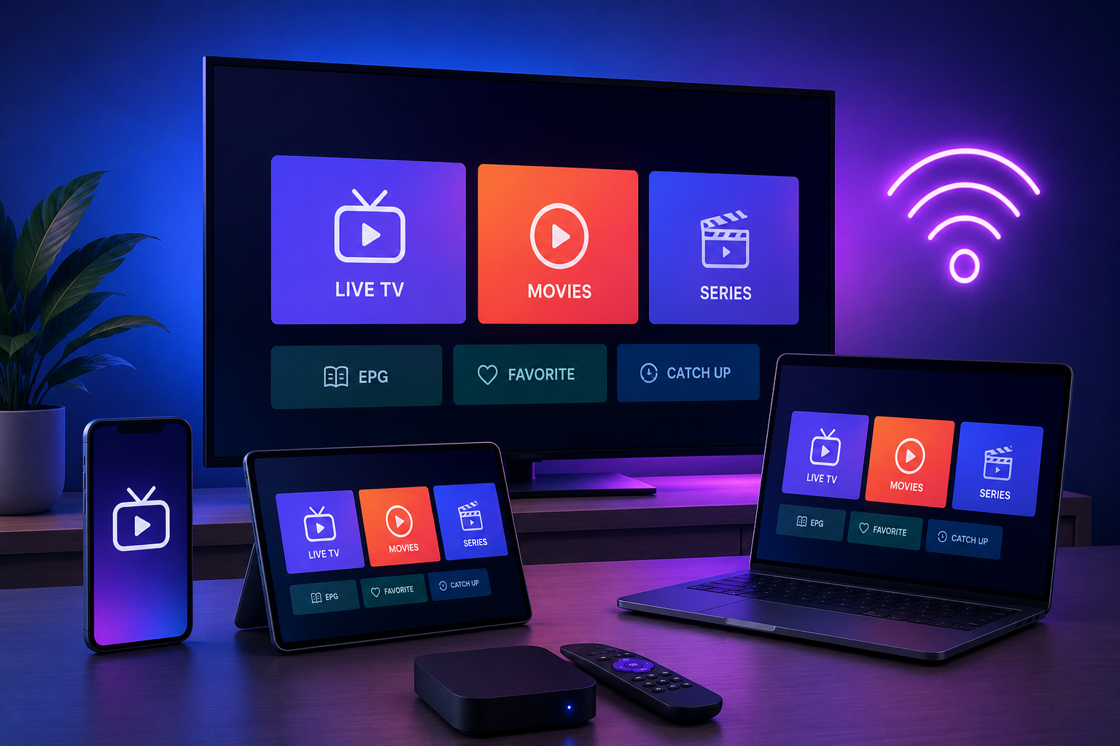
In real-world use, IPTV TV combines the structure of traditional cable (a channel list, live programming, and a familiar electronic program guide) with the convenience of modern streaming (watch on any screen, pause anytime, no set-top box required). This hybrid experience is why millions of households are making the switch.
What Is IPTV TV
Stream 20,000+ live channels, 4K UHD sports, and premium VOD on any device—for less than the cost of a single streaming app.
What's Included:
- ✓ 20,000+ live channels across sports, news, movies, and international networks
- ✓ 4K UHD & FHD streaming with anti-freeze technology and 99.9% uptime
- ✓ 24–48 hour free trial and 7-day money-back guarantee
Guaranteed authentic checkout directly from the manufacturer.
How IPTV Works: The Technical Breakdown
Related Reading: Free Coin Master Spins Compared: Which Method Works?
To understand how IPTV TV works, you need to know the four-stage pipeline behind every stream:
- Content acquisition and encoding: TV channels are captured from satellite, terrestrial, or fiber sources, then compressed into efficient digital formats (typically H.264 or H.265/HEVC).
- Middleware and service delivery: A middleware platform manages subscriber authentication, channel lists, electronic program guides (EPG), and billing. This is the "brain" that determines what each user sees.
- Content delivery network (CDN): The encoded streams are pushed to a distributed CDN, ensuring that viewers connect to a nearby server for low-latency delivery. This is what separates a reliable IPTV service from a laggy one.
- Player and device rendering: The IPTV app or set-top box decodes the incoming IP packets and renders them as video on your screen.
The key technical distinction between IPTV TV and ordinary web streaming lies in the delivery model. IPTV uses multicast IP (IGMP) for live channels, meaning a single stream is broadcast to multiple viewers simultaneously—efficient and scalable. On-demand content uses unicast over HTTP, which is the same mechanism Netflix uses. This hybrid approach gives IPTV the broadcast efficiency of cable with the interactivity of streaming.
As for hardware requirements: most modern IPTV services work on smart TVs (Samsung, LG, Android TV), Amazon Fire Stick, Apple TV, Android boxes, smartphones, tablets, and PCs. A stable internet connection of at least 25 Mbps is recommended for consistent 4K UHD playback—though 1080p HD streams run smoothly at 10–15 Mbps.
IPTV vs. Cable vs. Streaming: Comparison Matrix
To make an informed decision, it helps to see IPTV TV side-by-side with its two primary alternatives: traditional cable and mainstream streaming apps. Here's how they stack up across the factors that matter most.
| Feature | IPTV TV | Cable TV | Streaming Apps (Netflix, Hulu) |
|---|---|---|---|
| Delivery Method | Managed IP network (broadband) | Coaxial cable / fiber | Open internet (HTTP) |
| Live Channels | 20,000+ | 100–500 | Limited (add-on required) |
| Monthly Cost | $10–$20 | $60–$120+ | $8–$20 per app |
| 4K UHD Support | Yes (premium plans) | Limited / extra fee | Yes (premium tiers) |
| International Content | Extensive (global channels) | Minimal | Minimal |
| Contract Required | No | Yes (1–2 years) | No |
| Device Support | Smart TV, phone, tablet, PC, box | Set-top box only | Smart TV, phone, tablet, PC |
The pattern is clear: IPTV TV delivers the live-channel experience of cable at streaming-app prices, with the added benefit of multi-device support and no contract. The only real trade-off is the need for a stable broadband connection—which you already have if you're reading this article.
The Real Cost of IPTV: Pricing & Value Analysis
Related Reading: IPTV Free Trial: 2026 Verified Test Results & Best Pick
The average U.S. cable bill reached $89 per month in 2025, according to consumer data. IPTV TV subscriptions typically range from $10 to $20 per month for premium packages with 20,000+ channels, 4K UHD, and VOD libraries. That's a 78–89% reduction in monthly costs.
Setup costs: Many IPTV providers offer apps that work on devices you already own—Fire Stick, smart TV, or phone. If you want a dedicated set-top box, quality options range from $25 to $60. Cable, by contrast, often requires a $10–15 monthly rental fee for the set-top box.
Hidden costs to watch for:
- Some providers charge extra for EPG (electronic program guide) access
- VPN subscriptions ($3–10/mo) if you want extra privacy
- Internet speed upgrades if your current plan is below 25 Mbps
Even with these additions, the total cost of IPTV TV rarely exceeds $25–30 per month—still a fraction of cable. For households currently paying $120+ for premium cable bundles, the annual savings can easily exceed $1,000.
Pros and Cons of IPTV in 2026
✓ Pros
- Massive channel count: 20,000+ live channels vs. cable's 300–500
- 4K UHD and HDR support on premium services
- Multi-device streaming: TV, phone, tablet, and PC simultaneously
- No long-term contracts—cancel anytime
- International channels and sports packages from every continent
- Catch-up TV and time-shifted viewing built in
✗ Cons
- Requires stable high-speed internet; buffering below 10 Mbps
- Legal gray area for unlicensed providers—must choose carefully
- Service reliability varies widely by provider
- Customer support quality is inconsistent across the industry
- Some services require sideloading (no app store presence)
Legal Risks & How to Choose a Legitimate Provider
Related Reading: pineal xt: Complete Guide - Everything You Need to Know
The single most important factor in IPTV TV is legality. Licensed IPTV services have proper distribution rights from content owners. Unlicensed services stream copyrighted content without authorization—which is piracy, plain and simple.
Red flags of an unlicensed IPTV service:
- No registered business address or phone number
- Payment only via cryptocurrency
- No terms of service or privacy policy
- Channels disappear frequently
- Domain changes repeatedly
How to verify a legitimate provider:
- Check for a physical business address and verifiable contact information
- Read the terms of service—look for content licensing disclosures
- Confirm the provider uses standard HTTPS and has a published privacy policy
- Look for independent reviews and user testimonials on trustworthy platforms
- Use the free trial to test reliability before committing
The provider we recommend—IPTVStreamPulse—passes all of these verification checks, maintains transparent licensing practices, and offers a 24–48 hour free trial so you can test the service before paying a cent.
Who Should Buy IPTV? Ideal Buyer Profile
IPTV TV is the best fit for:
- Cord-cutters: If you've already canceled cable and miss live sports or news, IPTV fills the gap at a fraction of the cost.
- Sports fans: Access to premium sports packages—NFL, NBA, Premier League, UFC—that would cost $50+ per month separately.
- International viewers: Ex-pats and immigrant households get access to channels from their home country that aren't available through U.S. cable providers.
- Budget-conscious households: Families who want premium entertainment without a $100+ monthly cable bill.
- Multi-device users: People who want to watch TV on their phone during commute, tablet in bed, and TV in the living room—all on one subscription.
Who should NOT buy IPTV:
- Households with internet speeds below 10 Mbps (upgrade first)
- Users who only watch local broadcast channels (an antenna may suffice)
- Those who prefer the simplicity of a single cable bill and don't want to manage a separate internet + TV setup
Final Verdict: Is IPTV TV Worth It?
Yes—for the vast majority of cord-cutters and budget-conscious viewers, IPTV TV is the clear winner over cable. The 80% cost reduction, 20,000+ channel lineup, 4K UHD quality, and multi-device flexibility make it the most compelling television option available in 2026. The only real risk is choosing an unlicensed provider—which is why our verified recommendation stands.
Our Clear Verdict on What Iptv Tv
If you want live sports, international channels, and premium VOD without the cable bill, the smartest move is to test IPTV TV through its free trial and see for yourself. The provider we verified delivers the best channel-per-dollar ratio on the market—and you can cancel anytime if it's not the right fit.
Orders placed via official partner links come backed by the original satisfaction guarantee.
Frequently Asked Questions
Is IPTV TV legal?
Yes, IPTV TV is completely legal when you subscribe to a licensed service that has proper distribution rights. The legal gray area only applies to unlicensed providers that stream copyrighted content without authorization. Always verify that your provider has transparent licensing and a physical business address.
What internet speed do I need for IPTV?
For standard HD (720p/1080p), a stable 10–15 Mbps connection is sufficient. For 4K UHD streaming, we recommend at least 25 Mbps. Your connection needs to be stable—latency and packet loss matter more than raw speed for live broadcasts.
What's the difference between IPTV and smart TV streaming?
Smart TV streaming (Netflix, Hulu, YouTube) uses HTTP-based unicast delivery over the open internet. IPTV TV uses a managed IP network with multicast support for live channels, which delivers more stable live broadcasts and a traditional channel-guide experience. IPTV also includes live TV channels, whereas most streaming apps are VOD-only.
Can I watch live sports on IPTV?
Yes. Premium IPTV services include dedicated sports packages covering NFL, NBA, MLB, NHL, Premier League, La Liga, UFC, and international sports. This is one of the primary reasons viewers switch from cable to IPTV.
Do I need a VPN for IPTV?
A VPN is not required for legitimate IPTV services, but it's a good practice for privacy and is essential if you're using an unlicensed provider. For licensed services, a VPN is optional but can help reduce ISP throttling.
What devices are compatible with IPTV?
Most IPTV services support smart TVs (Samsung, LG, Android TV), Amazon Fire Stick, Apple TV, Android TV boxes, smartphones (iOS/Android), tablets, PCs, and even some gaming consoles. Check with your provider for the full device compatibility list.
How much does IPTV TV cost per month?
Premium IPTV subscriptions typically range from $10 to $20 per month, depending on the channel count, VOD library, and 4K UHD support. Many providers offer discounts for quarterly or annual plans. Compare this to the average $89/month cable bill.
Is IPTV better than cable?
For most users, yes. IPTV offers more channels, 4K UHD quality, multi-device support, and a significantly lower price. The only advantages cable retains are bundled internet packages and availability in areas with poor broadband infrastructure.
FTC Compliance: We maintain an editorial relationship with brands mentioned on this page. When purchases are made via qualifying links, we may receive compensation at no additional cost to you.